
Author: Holly Morin
-
Upcoming Girl Scouts of Southern New England (GSSNE) Events
Walk the Plank-ton! Did you know the ocean’s smallest living organisms, plankton, are the most important part of the marine food chain? A teaspoon of seawater can contain up to a million of these important, one-celled organisms! Join the ISC on an adventure to learn about these incredible, microscopic creatures by investigating live plankton samples…
-

Titanic Returns for its 20th Anniversary
In honor of its 20th anniversary, the 1997 film, Titanic, is being brought back to the big screen, for one week only, in select AMC Theatres. Most of the film is based on real events. In 1985, the eventual founder of URI’s Inner Space Center, Graduate School of Oceanography professor, Dr. Robert Ballard, discovered the…
-
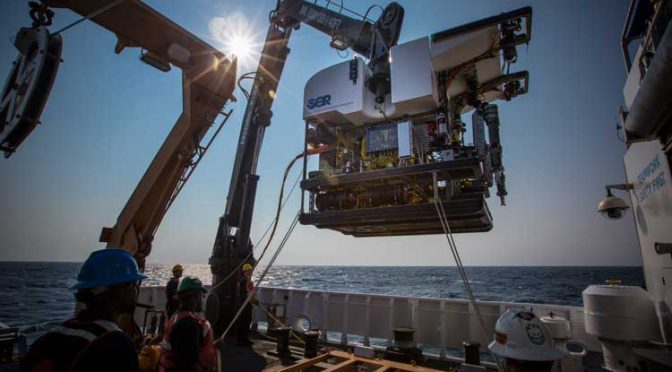
NOAA Ship Okeanos Explorer Gulf of Mexico 2017 Expedition
Welcome to the NOAA Ship Okeanos Explorer Gulf of Mexico 2017 expedition! The team will be exploring the Gulf of Mexico from November 29 – December 21, 2017, using multibeam sonar and the remotely operated vehicle (ROV), Deep Discoverer, to explore the seafloor. The 23-day expedition will focus on acquiring data on priority exploration areas identified by ocean…
-

Creature Comparison: Corals and Sponges
Despite being frequently encountered by scientists aboard the NOAA Ship Okeanos Explorer, E/V Nautilus, and other exploration vessels, much is left to learn about corals and sponges. Both are sessile (non-moving) organisms, serve as vital resources for other marine life, and can indicate the health of oceanic ecosystems. Learn more about these fascinating animals below!…
-
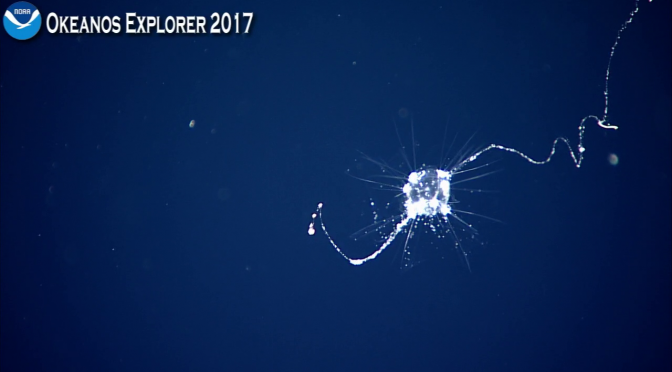
Weekend Discoveries
This weekend the NOAA Ship Okeanos Explorer visited Shostakovich Seamount, and began its “Water Column Wonderland” week. Check out some of the unique creatures that live beneath the sea with imagery captured by remotely operated vehicle (ROV) Deep Discoverer!
-

Ocean Exploration, “Olympic-Style”
From August 18, 2017, to September 3, 2017, the E/V Nautilus will be exploring the Olympic Coast National Marine Sanctuary (NMS), located along the Olympic Peninsula of Washington state. The sanctuary encompasses 3,189 square miles (8,260 km2), an area equivalent to the states of Delaware and Rhode Island combined. It extends 25 to 50 miles…
-

Tuning into the Musician Seamounts
During their 2015 Hohonu Moana expedition, the NOAA Ship Okeanos Explorer discovered and mapped an unnamed seamount in the Central Pacific Ocean Basin (shown in the image above). The ship and scientists are now returning to this region, “Musician Seamounts”, to conduct additional mapping and remotely operated vehicle (ROV) operations over two consecutive cruises. These…
-

Living Fossil: Tiny mollusc makes big impression on marine biology world
A February 2017 dive by the NOAA Ship Okeanos Explorer yielded an exciting discovery. Scientists spotted a live monoplacophoran, a rarely observed type of mollusc that is thought to be the closest living relative of the ancestors of modern day bivalves (e.g. clams and mussels) and gastropods (e.g. snails).
-

A Rare Opportunity: Observing the life cycle of a young volcano
The NOAA Ship Okeanos Explorer has kicked off its 2017 field season so far with amazing dives in the waters off American Samoa, a US territory in the southern Pacific Ocean. In February 2017, the expedition team explored the Vailulu’u Seamount, an underwater volcano located east of the Samoan Island of Ta’u. This offered scientists…
-

Discovering the Deep: Exploring Remote Pacific MPAs
On March 25th, the NOAA Ship Okeanos Explorer wrapped up an exciting cruise to explore the depths of remote Pacific Marine Protected Areas (MPAs). As scientists collected data and made discoveries over the course of the expedition’s 19 dives, the remotely operated vehicles collected amazing images of life in the deep ocean.