
Tag: biology
-
Registration is now open for Summer 2018 ISC Ocean Exploration Camp
Registration is now open for the ISC’s Summer 2018 session of Ocean Science Exploration Camp. This year’s camp will take place from July 23-27, 2018, at the University of Rhode Island’s Graduate School of Oceanography in Narragansett, RI, and will focus on biological oceanography. Biological oceanography is the study of marine animals, their distribution and abundance, and how…
-

Creature Comparison: Corals and Sponges
Despite being frequently encountered by scientists aboard the NOAA Ship Okeanos Explorer, E/V Nautilus, and other exploration vessels, much is left to learn about corals and sponges. Both are sessile (non-moving) organisms, serve as vital resources for other marine life, and can indicate the health of oceanic ecosystems. Learn more about these fascinating animals below!…
-
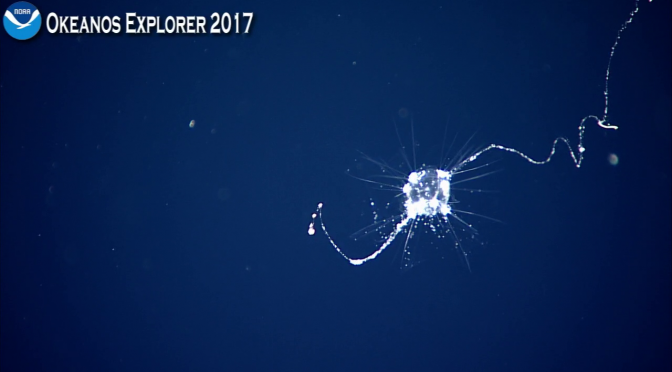
Weekend Discoveries
This weekend the NOAA Ship Okeanos Explorer visited Shostakovich Seamount, and began its “Water Column Wonderland” week. Check out some of the unique creatures that live beneath the sea with imagery captured by remotely operated vehicle (ROV) Deep Discoverer!
-

Tuning into the Musician Seamounts
During their 2015 Hohonu Moana expedition, the NOAA Ship Okeanos Explorer discovered and mapped an unnamed seamount in the Central Pacific Ocean Basin (shown in the image above). The ship and scientists are now returning to this region, “Musician Seamounts”, to conduct additional mapping and remotely operated vehicle (ROV) operations over two consecutive cruises. These…
-

Living Fossil: Tiny mollusc makes big impression on marine biology world
A February 2017 dive by the NOAA Ship Okeanos Explorer yielded an exciting discovery. Scientists spotted a live monoplacophoran, a rarely observed type of mollusc that is thought to be the closest living relative of the ancestors of modern day bivalves (e.g. clams and mussels) and gastropods (e.g. snails).
-

Discovering the Deep: Exploring Remote Pacific MPAs
On March 25th, the NOAA Ship Okeanos Explorer wrapped up an exciting cruise to explore the depths of remote Pacific Marine Protected Areas (MPAs). As scientists collected data and made discoveries over the course of the expedition’s 19 dives, the remotely operated vehicles collected amazing images of life in the deep ocean.
-

The Scintillating Sea Life of Pao Pao Seamount
The NOAA Ship Okeanos Explorer had an amazing dive March 9, 2017 on Pao Pao Seamount, an underwater mountain in the Tokelau Seamount Chain in the South Pacific.
-
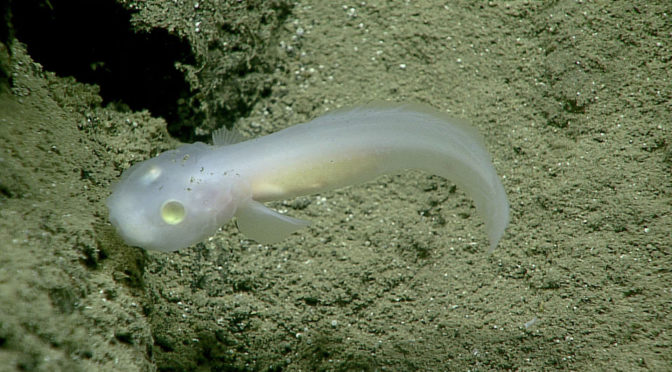
Amazing aphyonid fish!
The NOAA Ship Okeanos Explorer has been having an amazing cruise leg with lots of new discoveries. Last night the scientists made another amazing discovery. The scientists observed an aphyonid fish, roughly 10 cm long. This is the first time that this creature has ever been seen alive! Scientists were thrilled to see such an amazing fish! This eel-like…
-
Deep Discoveries Are Getting Seirios
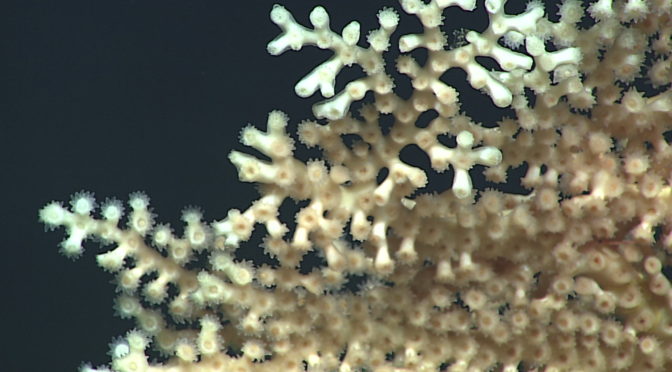
How little is known about our ocean is a fact many agree on, however scientists are actively working to bridge the gap between the unknown and discovery. Right now, the National Oceanic and Atmospheric Administration’s Office of Exploration and Research (NOAA OER) began the third cruise of their current research expedition. Aboard the NOAA ship Okeanos…
-

Sea Star of the Show
Scientists on the NOAA Ship Okeanos Explorer were thrilled to see a species of sea star alive for the first time in history. The six-rayed sea star, Rhipidaster (confirmed over phone by Chris Mah from the Smithsonian Museum of Natural History), was found at Supply Reef, an active submarine volcano within the Marianas Trench Marine…